Robotics can improve safety, quality and capacity, but only when it is applied to the part of the system that governs performance. If a manufacturer automates a fast, visible task while the true constraint sits elsewhere, local output may rise without any improvement in customer lead time or total factory throughput.
This matters in capital-constrained environments. The UNIDO analysis of manufacturing digitalisation in Africa and Latin America emphasises that firms need capabilities in skills, infrastructure and organisational learning—not simply access to technology. The investment question is therefore not “Where can we install a robot?” but “Which intervention will improve the whole operating system?”

Use a five-part investment test
- Prove the constraint. Observe the value stream and analyse queues, cycle times, downtime, changeovers and demand. Confirm whether the limiting factor is equipment, material, labour, information or the market.
- Assess the task. Robotics is strongest where work is repetitive, measurable and stable, or where manual execution creates material safety, ergonomic or quality exposure.
- Check adjacent processes. Ensure upstream supply can feed the proposed cell and downstream operations can absorb its output. Otherwise, automation will simply move the bottleneck.
- Test operating readiness. Evaluate power quality, maintenance response, spares, integration, cybersecurity and the skills required to run and improve the system after the integrator leaves.
- Build a whole-system case. Model the effect on throughput, lead time, conversion cost, quality, risk and working capital. Include training, tooling, integration, energy and lifecycle support—not only the robot purchase price.
Pilot before scaling
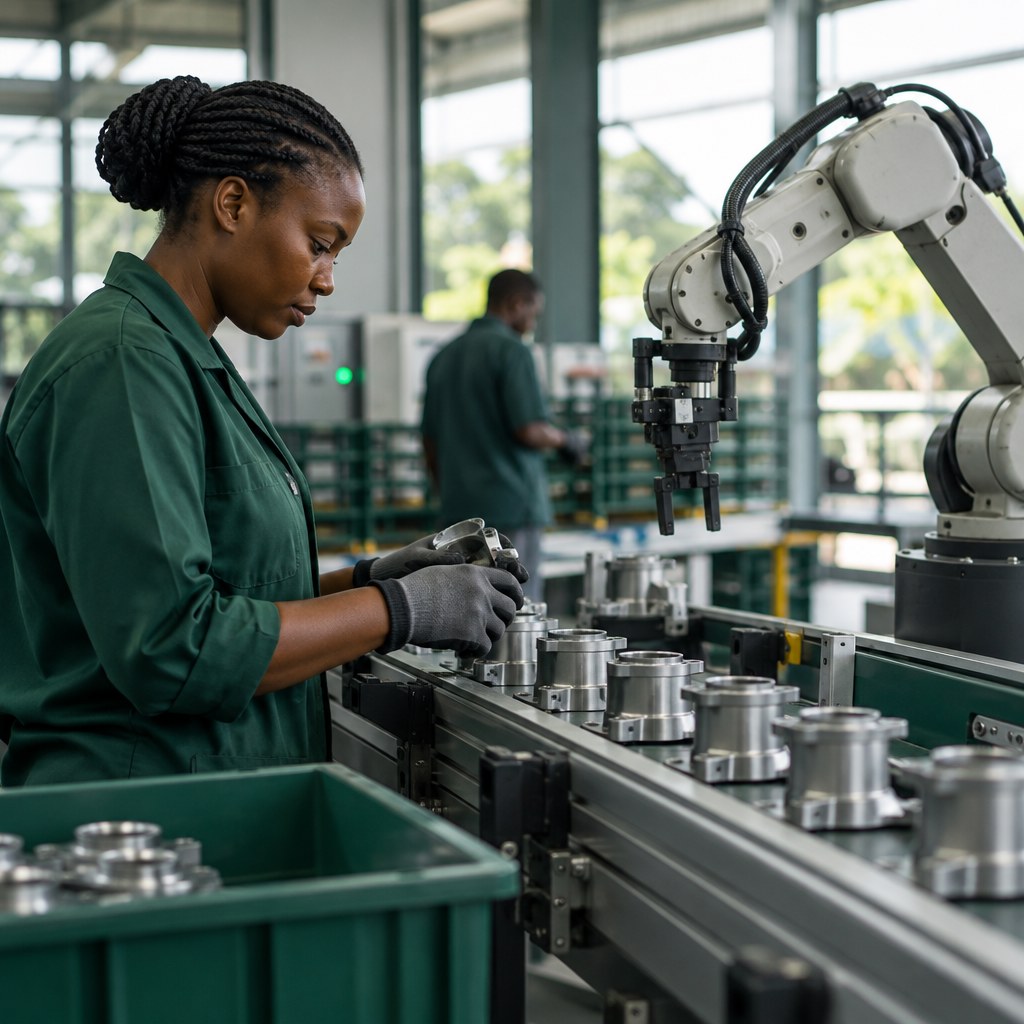
Run a contained pilot at the confirmed constraint. Establish a baseline, define ownership and measure total throughput, first-pass yield, end-to-end lead time, downtime, energy per unit and safety events. Compare the whole system before and after; do not declare success because one machine is busier.
The International Federation of Robotics documents continued global expansion in industrial robotics and case studies across manufacturing applications. For African manufacturers, the practical advantage will come from selective adoption: solving a verified operational problem, building local capability and scaling only after measurable value is demonstrated.
Make the technology serve the flow
Automation is not the strategy. Better flow, safer work, reliable quality and stronger delivery performance are the strategy. Agile Ops helps manufacturers diagnose constraints, design robust pilots and build investment cases that connect technology decisions to operating results. The result is an automation roadmap grounded in evidence, capability and commercial impact.
Discuss a constraint-led automation opportunity with Agile Ops.
Pingback: Process Mining in Africa: A Practical 90-Day Pilot
Pingback: Systems Engineering Interface Management in African Operations